Bruce Gibson ND
Inner
EcologyRegenerative Wellness
The living, interconnected web of processes that sustains and shapes the human being from within — and through which we are, in turn, sustained and shaped by the world around us.
What Is Inner Ecology
Inner Ecology is the living, interconnected web of biological, neurological, psychological, sociological, energetic, environmental, and spiritual processes that sustain and shape the human being from within - and through which we are, in turn, sustained and shaped by the world around us. Inner Ecology Repatterning™ (IER) is the practitioner framework and training programme developed by Bruce Gibson ND to apply this understanding in clinical practice. IER is an educational framework; it is not a medical treatment and does not replace diagnosis, treatment, or emergency care.
How the Framework Fits Together
Wholistic Ecology™
The wider paradigm
The broader philosophical worldview - health understood as an expression of living systems in relationship with each other and the natural world.
Vitality Balancing
Related educational work
A related body of educational work developed through the Australian College of Vital Health alongside the Inner Ecology Repatterning framework.
Visit vitalitybalancing.com ↗Inner Ecology
The foundational model
The living system within the human being: the seven interconnected domains of biological, neurological, psychological, sociological, energetic, environmental and spiritual experience.
Inner Ecology Repatterning™
The practitioner framework
The clinical training and assessment framework that applies the Inner Ecology model in professional practice. Its operational expression is the 7-Step Inner Ecology Process.
7-Step Inner Ecology Process
The operational expression
Observe · Map · Identify · Prioritise · Repattern · Integrate · Review. The practitioner pathway for moving from whole-ecology understanding to responsive clinical application.
The Seven Domains
Where the ecology operates
Biological · Neurological · Psychological · Sociological · Energetic · Environmental · Spiritual. The map of the whole-person system used in IER assessment.
The Five Regenerative Levers
How change is supported
Coherence, Energy and Capacity, Timing and Rhythms, Inputs and Environment and Flow and Elimination. The five mechanisms through which the living system reorganises toward health.
9 Principles of Wholistic Naturopathy
The philosophical foundation
The six classical naturopathic principles extended by three regenerative principles - the philosophical and ethical ground from which IER practice grows.
Vital Health Roots is the outer-ecology and regenerative-health curriculum that forms Part 2 of the IER Practitioner Training. It covers the gut microbiome, circadian biology, regenerative nutrition, environmental medicine, and relational ecology - the outer conditions that support inner change.
A living system,
not a collection
of parts.
Inner Ecology is the living, interconnected web of biological, neurological, psychological, sociological, energetic, environmental, and spiritual processes that sustain and shape the human being from within - and through which we are, in turn, sustained and shaped by the world around us.
Like the living soil beneath a forest, or the unseen mycorrhizal networks that bind root to root across vast distances, our inner ecology operates as a whole - every layer in constant conversation with every other.
The gut nourishes the mind. The nervous system listens to the heart. Belief shapes biology. The stories carried in family lines influence the nervous system long before conscious memory begins. From this perspective, each layer of experience participates in the whole.
Nature is not merely a backdrop to human health. From the Inner Ecology view, it is the original pattern from which our inner ecology was formed, and to which it continually returns for renewal. The seasons teach us rhythm. The soil reminds us of our substrate. The river shows us how to move without force.
When this inner ecology loses coherence - through chronic poor nourishment, unresolved emotional patterns, toxic burden, or disconnection from the natural world - the whole system tends to reflect that disruption. Inner Ecology works with symptoms as signals from the ecology, rather than problems to be suppressed in isolation.
Research background
Inner Ecology is an educational and clinical philosophy framework. Content is reviewed by Bruce Gibson ND and is not a substitute for personalised medical advice.
"Inner Ecology is the study, recognition, and honouring of that living system within - and the practice of restoring it to its natural coherence, wholeness, and vitality."
Bruce Gibson ND
The Framework
The Seven Domains
Biological, Neurological, Psychological, Sociological, Energetic, Environmental and Spiritual, seven interwoven domains that map the human system as a living ecology. All seven are addressed together, because in a living system everything is already in conversation with everything else.
Explore the Seven Domains →The Mechanisms
The Five Regenerative Levers
Coherence, Energy and Capacity, Timing and Rhythms, Inputs and Environment and Flow and Elimination. Five levers through which the living system continually organises itself, and through which lasting, regenerative change becomes possible.
Discover the Five Levers →The Foundation
9 Principles of Wholistic Naturopathy
The classical six naturopathic principles — Vis Medicatrix Naturae, Tolle Causam, Primum Non Nocere, Docere, Tolle Totum and Praevenire — extended by three regenerative principles for contemporary wholistic practice. The philosophical foundation of Inner Ecology Repatterning.
Read the 9 Principles →About the Founder
Bruce Gibson ND
Naturopath, herbalist, bodyworker and regenerative health educator with over 30 years of clinical practice across Australia and internationally. Bruce developed Inner Ecology Repatterning through decades of integrated clinical work.
Meet Bruce Gibson →Questions
Frequently Asked Questions
Who is the training for? What does Inner Ecology Repatterning involve? How is it different from other approaches? The most common questions from practitioners and curious readers, plainly answered.
Browse the FAQ →Free Inner Ecology Guide
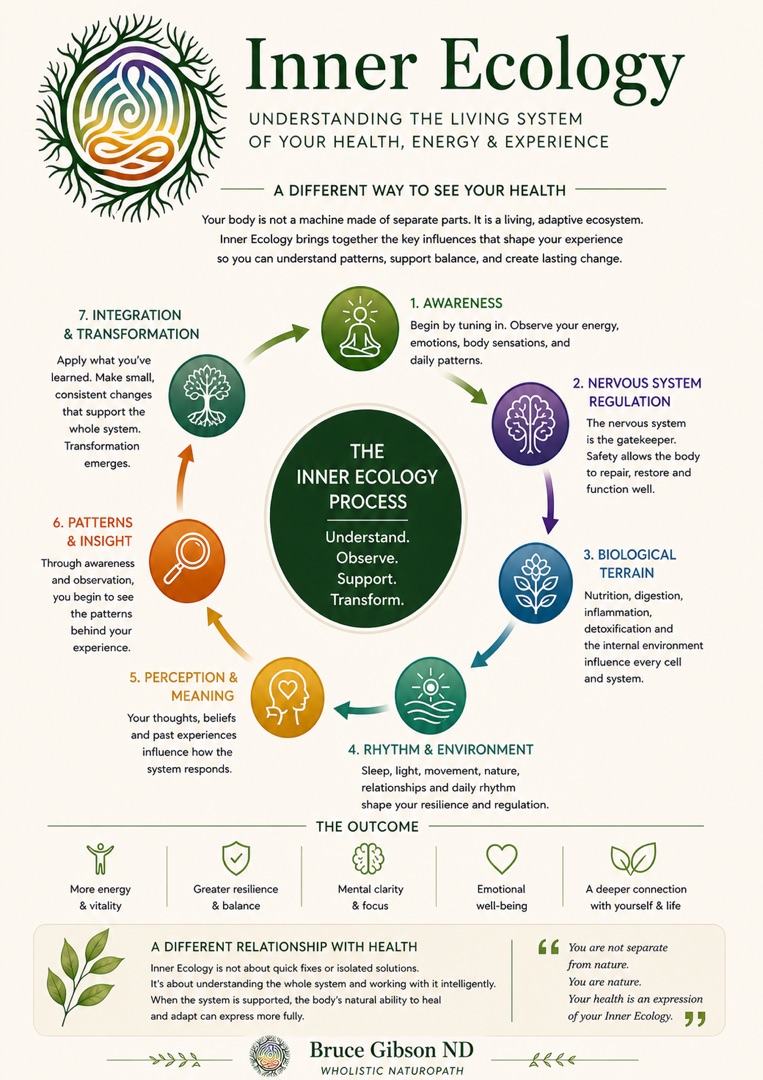
Understanding the living system of your health, energy & experience
A free 15-page guide that introduces the Inner Ecology lens, how the body, nervous system, environment and relationships form one adaptive ecosystem, and what that means for health, energy and lasting change.
Common Questions
Questions, plainly answered
- What is Inner Ecology Repatterning?
- Inner Ecology Repatterning (IER) is a practitioner framework created by Bruce Gibson ND in Australia. It teaches health professionals to understand wellbeing as one interconnected living system — spanning body, nervous system, environment, relationships, and meaning — rather than treating symptoms as isolated problems. Its operational expression is the 7-Step Inner Ecology Process, which guides practitioners from observing the ecology through to reviewing how it is changing.
- Who is the IER practitioner training for?
- The training is designed for naturopaths, nutritionists, integrative health practitioners, somatic practitioners, health coaches, and experienced wellness professionals who want a structured whole-systems framework for client assessment and education. Participants come from across Australia and internationally. You should be working with clients in a health or wellbeing context and ready to deepen your clinical thinking.
- How long is the training and how is it delivered?
- The IER Practitioner Training is a three-part, 32-week online programme: Part 1 — Embodied Foundations of Regenerative Repatterning (8 weeks), Part 2 — Outer Ecology and Vital Health Roots (8 weeks), and Part 3 — The Practitioner Immersion (16 weeks). Each part includes weekly training module content, study guides, and daily practices. Part 3 introduces advanced practitioner reference frameworks and fortnightly live supervision calls with Bruce Gibson ND. Everything is delivered online in English.
- Is there a free resource to start with?
- Yes. "Understanding the Living System" is a free 15-page guide by Bruce Gibson ND that introduces the Inner Ecology view of health — how body, nervous system, environment, relationships, and meaning form one coherent living system. It is a clear, practical starting point before exploring the full training programme. You can download it from the Free Guide section on this page.
More questions answered on the full FAQ page →
Connect
Begin the conversation
Curious about the framework, the practitioner training, or your own path toward regenerative wellness? We would love to hear from you.
Get in Touch