Bruce Gibson ND
The living, interconnected web of processes that sustains and shapes the human being from within - and through which we are, in turn, sustained and shaped by the world around us.
What Is Inner Ecology
Inner Ecology is the living, interconnected web of biological, neurological, psychological, sociological, energetic, environmental, and spiritual processes that sustains and shapes the human being from within.
Like the living soil beneath a forest, or the unseen mycorrhizal networks that bind root to root across vast distances, our inner ecology operates as a whole - every layer in constant conversation with every other.
The gut nourishes the mind. The nervous system listens to the heart. Belief shapes biology. The stories carried in family lines influence the nervous system long before conscious memory begins. From this perspective, each layer of experience participates in the whole.
Nature is not merely a backdrop to human health. From the Inner Ecology view, it is the original pattern from which our inner ecology was formed, and to which it continually returns for renewal. The seasons teach us rhythm. The soil reminds us of our substrate. The river shows us how to move without force.
When this inner ecology loses coherence - through chronic poor nourishment, unresolved emotional patterns, toxic burden, or disconnection from the natural world - the whole system tends to reflect that disruption. Inner Ecology works with symptoms as signals from the ecology, rather than problems to be suppressed in isolation.
Research background
Inner Ecology is an educational and clinical philosophy framework. Content is reviewed by Bruce Gibson ND and is not a substitute for personalised medical advice.
"Inner Ecology is the study, recognition, and honouring of that living system within - and the practice of restoring it to its natural coherence, wholeness, and vitality."
Bruce Gibson ND
The Framework
All seven domains are addressed simultaneously as an integrated whole. In a living ecology, everything is already in conversation with everything else.
The Living Substrate
The gut microbiome, nutritional biochemistry, and cellular environment. The foundational substrate - like the forest floor - from which all other domains draw strength.
The Communication Network
Nervous system patterning, stress response, brain chemistry. The body's vast, invisible communication architecture - shaped by every layer, and simultaneously shaping them all.
The Stories We Carry
Beliefs, emotions, unconscious patterns, mental frameworks. The living architecture of the mind - shaped as much by what we have encountered as by what we inherently are.
The Relational Field
Family systems, cultural conditioning, intergenerational patterns, community bonds. No tree in the forest is truly individual - and neither are we.
The Animating Current
Vital force, meridian pathways, bioelectric fields. The animating dimension that explains why two people with identical biochemistry can have profoundly different vitality.
The Original Pattern
Relationship to the natural world: food, soil, water, seasons, nature connection. Nature is the original pattern from which the inner ecology was formed.
The Orienting Dimension
Purpose, meaning, connection to the greater web of life. The dimension that asks: What is this life for? What calls me forward? To what larger story do I belong?
Research background
The Seven Domains describe the Inner Ecology conceptual framework. Individual health and clinical decisions should be guided by a qualified practitioner. Reviewed by Bruce Gibson ND.
The Mechanisms
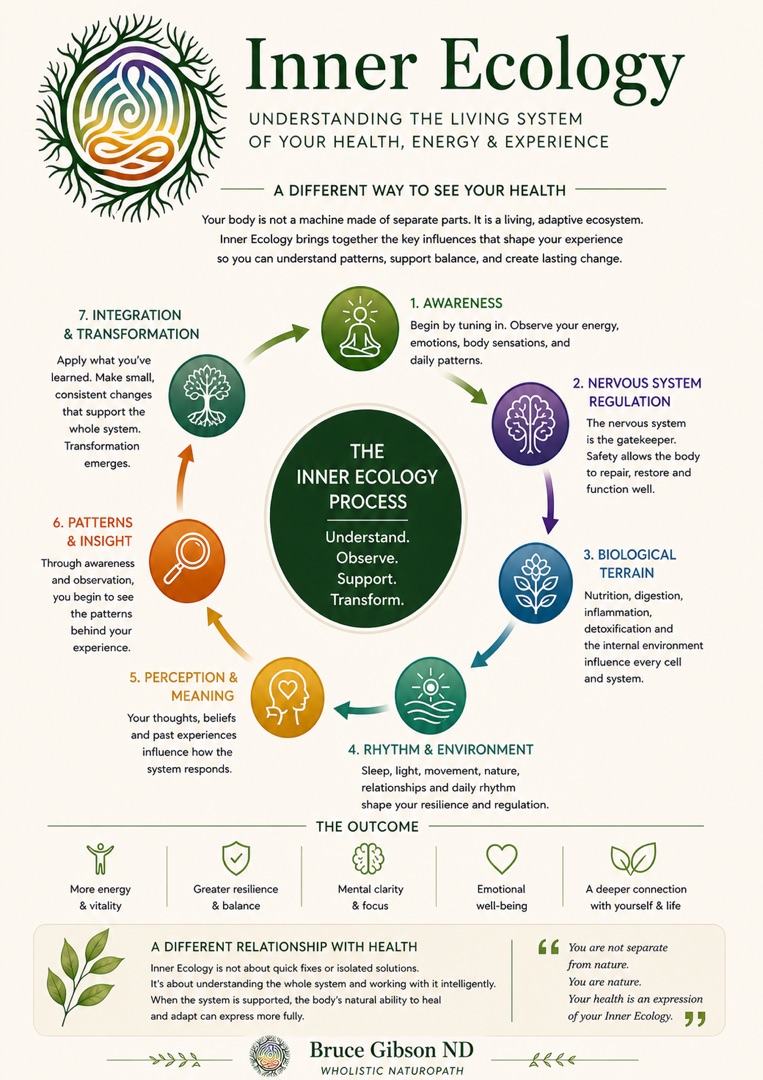
Inner Ecology is built on the view that the body functions as a living, adaptive ecosystem - constantly responding to inputs, relationships, rhythms, and environment - rather than a machine of separate parts.
These five levers describe the domains through which the system continually organises and reorganises itself. The clinical philosophy holds that repatterning is most effective when all five are addressed together, rather than in isolation.
Nervous System and System Integration
Inner Ecology holds that nervous-system regulation plays a central role in how the body integrates change. When the system is in a more coherent state, research in polyvagal theory and psychoneuroimmunology suggests communication between systems becomes more efficient and adaptive. Without regulation, many interventions are harder to integrate.
Mitochondrial Function and Vital Reserves
Recovery and adaptation require metabolic resources. From a clinical ecology perspective, the body needs sufficient capacity - not just to maintain function, but to support repair, detoxification, and regeneration. This lever addresses the restoration of metabolic resilience and sustainable vitality.
Circadian Biology and Cyclical Processes
Circadian biology research shows the body is strongly governed by daily and seasonal rhythms. These cycles regulate hormones, digestion, sleep, and cellular repair. When timing is consistently disrupted, physiology can become disorganised. Restoring rhythm is a core element of the Inner Ecology approach.
Nutrition, Toxins and Sensory Load
Every input - whether food, air, water, light, or information - shapes the terrain of the inner ecology. This lever focuses on reducing unnecessary interference while providing the essential inputs research links to optimal biological function.
Detoxification and Movement of Fluids
From an ecological health perspective, vitality depends on flow. The movement of blood, lymph, breath, and cellular waste is essential to function. When flow is obstructed, stagnation and inflammatory patterns can follow. Supporting these processes is a foundational element of clinical practice.
Research background
The Five Levers describe a clinical philosophy framework, not a medical protocol. Individual health decisions should be made in consultation with a qualified practitioner. Reviewed by Bruce Gibson ND.
"True health is not something we impose. It is something that emerges when the conditions are right. This is the work of regeneration. And it begins within."
Bruce Gibson ND
The Philosophy
These principles form the clinical philosophy behind Inner Ecology Repatterning. They draw on established fields including polyvagal theory, circadian biology, somatic psychology, and systems thinking, integrated within a wholistic naturopathic framework. They guide how we understand the human system, how we approach change, and how we work with the adaptive intelligence already present within every person.
Inner Ecology Repatterning is a practice of returning the human system to coherence. It is the process of learning to observe, stabilise, and gently reshape the patterns within us - while creating the conditions in our body, environment, and life that allow those changes to take root and sustain.
Bruce Gibson ND
Research background
These principles represent the clinical philosophy of Inner Ecology Repatterning, informed by research in the fields listed. They do not constitute medical diagnosis or treatment. Reviewed by Bruce Gibson ND.

About the Founder
Over more than 30 years of practice in natural medicine - as a naturopath (ND), medical herbalist, bodyworker, and regenerative health educator - Bruce Gibson has worked with individuals and groups across Australia and internationally. His formal training encompasses wholistic naturopathy, herbal medicine, somatic bodywork, and Polarity Therapy, alongside advanced study in polyvagal theory, Ericksonian hypnotherapy, NLP, kinesiology, and somatic psychology.
Bruce has taught and lectured in natural medicine education contexts, supervised practitioners in clinical practice, and developed the Inner Ecology Repatterning framework over many years of integrated clinical work. Inner Ecology draws on wholistic naturopathy alongside established fields including neuroscience, circadian biology, somatic psychology, and polyvagal-informed practice - synthesised into a coherent, evidence-informed clinical philosophy.
His work is guided by a central clinical principle: that lasting health change is most supported when the whole system - nervous system, biology, environment, and meaning - is brought into coherence together.
Qualifications & background: ND (Naturopath), Diplomas in Herbal Medicine and Somatic Bodywork, advanced training in polyvagal theory, Ericksonian hypnotherapy, NLP, and kinesiology. Over 30 years in clinical practice in Australia. Educator and curriculum developer in naturopathic and integrative health contexts.
Content reviewed by Bruce Gibson ND. Inner Ecology is an educational and clinical philosophy framework. It is not a substitute for personalised medical advice.
Free Inner Ecology Guide
A free 15-page guide that introduces the Inner Ecology lens — how the body, nervous system, environment and relationships form one adaptive ecosystem, and what that means for health, energy and lasting change.

Connect
Whether you are a health practitioner curious about the Inner Ecology framework, someone exploring your own path toward regenerative wellness, or a professional interested in the training programme - we would love to hear from you.
The practitioner training programme - Inner Ecology Repatterning - will be opening enrolments soon. Leave your details and we will be in touch when registration opens.
Inner Ecology content is for educational and professional development purposes. It is not a substitute for personalised medical advice. Practitioner Training is a clinical philosophy programme reviewed by Bruce Gibson ND (naturopath, 30+ years clinical practice, Australia).
Three-level practitioner training
Online portal with drip-fed modules
Developed by Bruce Gibson ND
Integrating naturopathy, neuroscience and somatic practice